
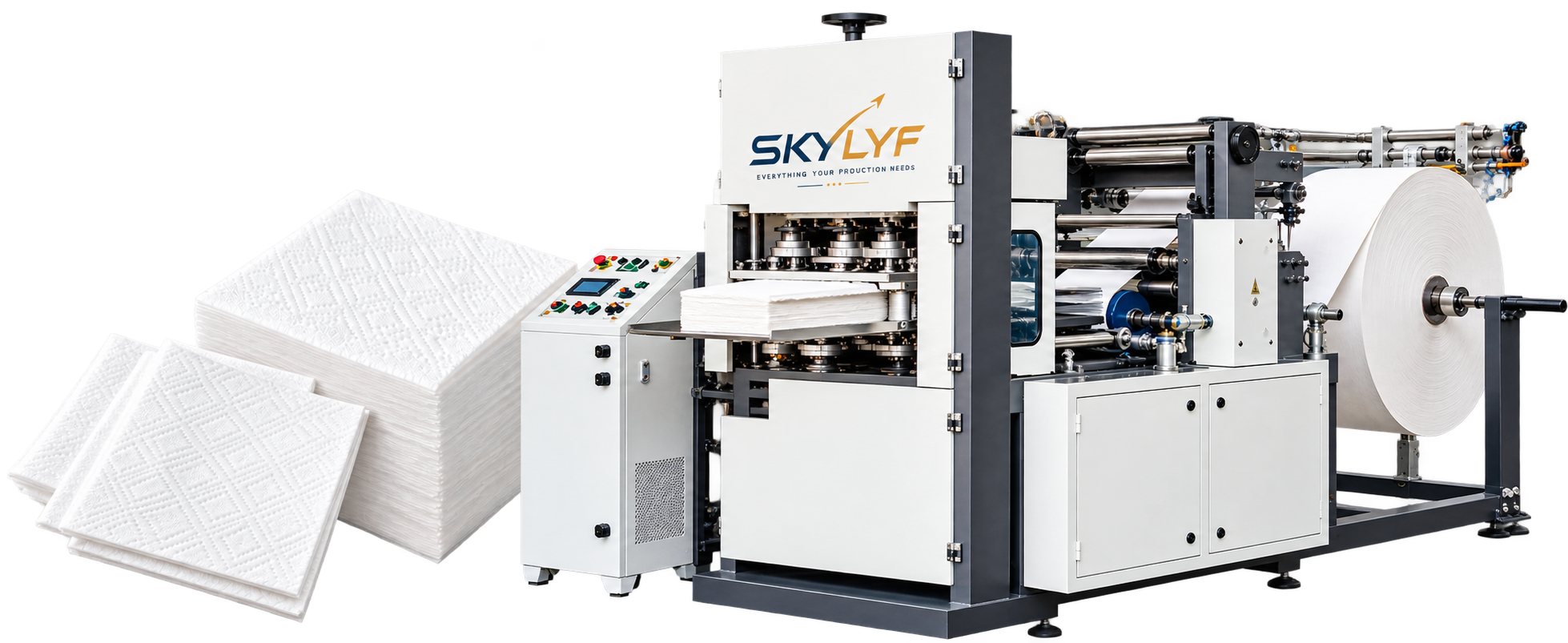
Single Emboss Without Printing
A practical solution for producing folded tissue napkins with a single embossing process and without a printing unit. Explore the working process, applications, features and important considerations before selecting a machine.
What Is a Single Emboss Without Printing Tissue Napkin Machine?
A Single Emboss Without Printing Tissue Napkin Making Machine is designed for converting tissue paper into folded napkins using a single embossing process.
Unlike a printed tissue napkin machine, this configuration does not use a printing unit. Instead, the tissue passes through an embossing section where a pattern or texture can be created on the paper.
The exact machine configuration, production capacity, supported paper specifications and finished napkin sizes may vary depending on the selected model.
Tissue paper is processed through the required converting stages such as unwinding, embossing, folding and cutting.
A counting or collection system may be provided depending on the machine configuration.
How Does the Machine Work?
The tissue converting process starts with the feeding of tissue paper into the machine. The paper then passes through different sections according to the machine configuration.
Tissue Unwinding
The tissue paper roll is installed on the unwinding section and supplied to the production line.
Paper Feeding
The tissue is guided through the feeding section while maintaining controlled paper movement.
Single Embossing
The tissue passes through the embossing section where the selected embossing pattern is formed.
Folding
The embossed tissue is folded according to the required napkin format and machine configuration.
Cutting
The folded tissue is cut into individual napkins.
Collection
Finished napkins are collected at the output section for further handling and packaging.
Tissue Napkin Production Flow
Key Features
Single Embossing
Designed around a single embossing process for creating a textured tissue surface.
Without Printing
The configuration does not require a printing unit for producing plain embossed napkins.
Continuous Processing
Different converting operations can be integrated into one production process.
Folding System
The folding section converts the tissue web into the required napkin format.
Cutting
The cutting section separates the folded tissue into individual napkins.
Machine Configuration
Specifications and available features can vary according to the selected machine model.
Advantages of Single Emboss Without Printing
A single emboss configuration can be suitable for manufacturers who want to produce tissue napkins with a textured appearance without adding a printing operation.
Embossing can add texture and visual detail to the finished tissue napkin.
Suitable where printed designs are not required.
The machine focuses on essential tissue converting operations.
Embossed tissue napkins can be used in several commercial and food-service applications.
Applications of Embossed Tissue Napkins
Single embossed tissue napkins can be used in various everyday and commercial environments.
Importance of Tissue Paper Quality
Machine performance and finished napkin quality can depend on the characteristics of the tissue paper being processed.
Factors such as paper GSM, strength, moisture, softness, roll condition and paper consistency may influence the converting process.
Single Emboss Without Printing vs Printed Napkin
| Feature | Single Emboss Without Printing | Printed Configuration |
|---|---|---|
| Embossing | Single embossing | Depends on configuration |
| Printing | No | Yes |
| Ink | Not required for printing | Used as part of printing process |
| Product Appearance | Embossed texture | Printed design with possible embossing |
| Application | Plain embossed napkins | Printed or branded napkins |
What to Consider Before Selecting a Machine?
Before purchasing a tissue napkin making machine, manufacturers should clearly define their product and production requirements.
Decide the required finished napkin dimensions.
Confirm the tissue paper characteristics suitable for your intended product.
Confirm whether single embossing meets your product requirement.
Discuss the required production capacity before selecting the machine model.
Confirm the folding style required for your finished napkin.
Consider installation, training, spare parts and technical support requirements.
Maintenance Considerations
Regular inspection and maintenance are important for keeping tissue converting equipment in proper operating condition.
Depending on the machine design, operators may need to regularly inspect the embossing components, cutting section, folding components, bearings, belts, sensors, pneumatic components and electrical connections.
Cleaning tissue dust and following the recommended maintenance schedule can also help maintain the machine in suitable working condition.
Why Consider SKYLYF Machinery?
SKYLYF Machinery manufactures and supplies machinery for the paper and disposable product industry.
Our tissue converting machine solutions are developed for different production requirements, with machine configurations selected according to the customer’s product specifications.
For a single emboss without printing application, the machine configuration can be discussed according to requirements such as tissue paper specifications, finished napkin size, folding format, embossing requirements and desired production capacity.
Frequently Asked Questions
What is a single emboss tissue napkin making machine?
Does this machine include printing?
What is the purpose of embossing?
What factors can affect production performance?
Can machine specifications vary?
Who can use embossed tissue napkins?
Looking for a Tissue Napkin Making Machine?
Discuss your tissue paper specifications, napkin size, embossing requirement and production requirements with SKYLYF Machinery to identify a suitable machine configuration.
Contact SKYLYF Machinery